Episode Transcript
[00:00:03] Speaker A: Hello and welcome to Women of the Middle east podcast. Women of the Middle East.
This podcast relates the realities of Arab women and their rich and diverse experiences. It aims to present the multiplicity of their voices and wishes to break overdue cultural stereotypes about women of the Middle East. My name is Amal Malki. I'm a feminist scholar and educator. This is Women of the Middle East.
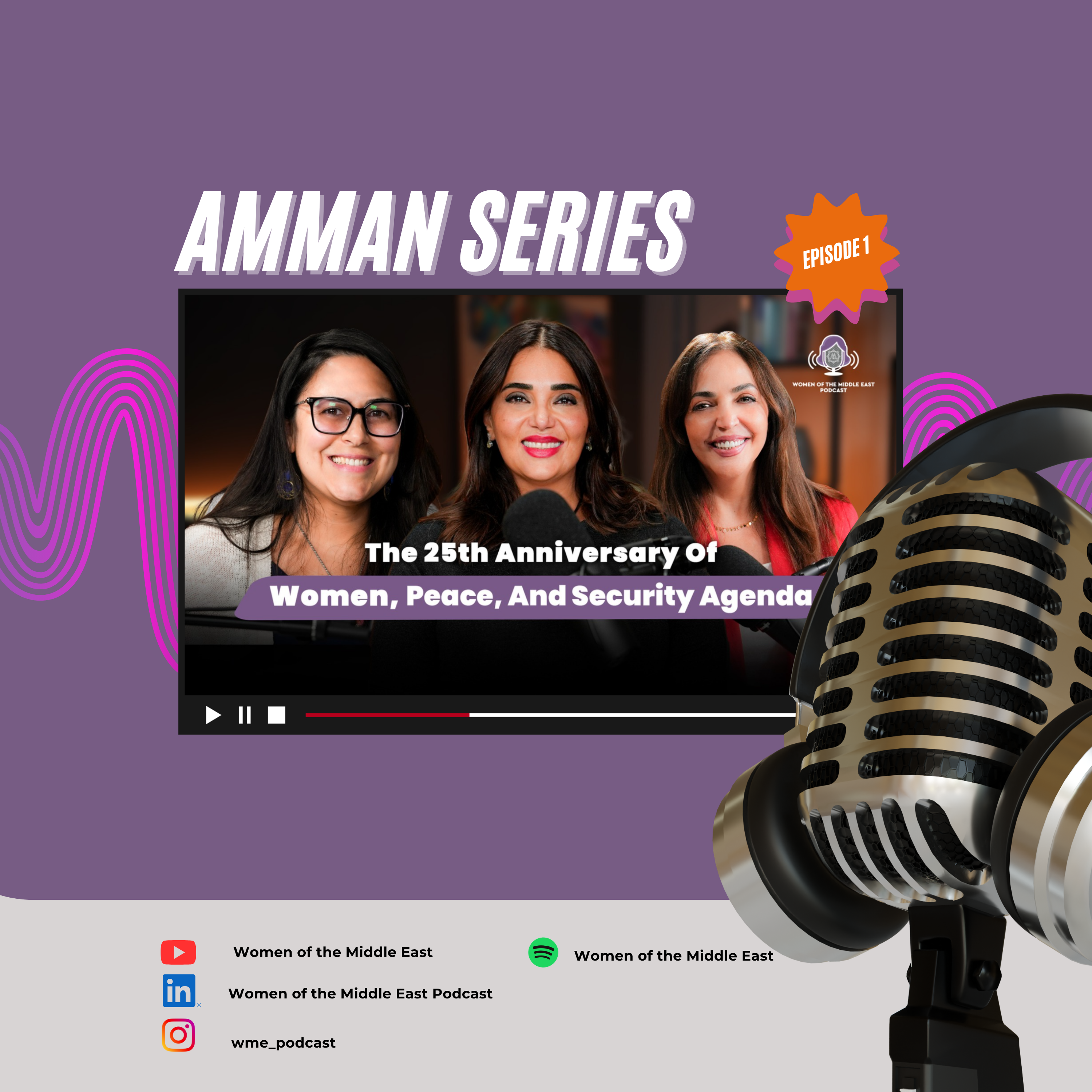
Hello and welcome to Women of the Middle East Podcast. We're here in Amman, Jordan to observe the 1325 UN's resolution, Women Peace and security agenda. We're here gathered with other stakeholders, NGOs, women organizations from the region, as well as international organization to discuss this very important matter in light of the regional political atmosphere that we are living in. I have two amazing guests today. I have Fida Al Musa from Palestine and I've got Shireen Jerdi from Lebanon. Welcome.
[00:01:06] Speaker B: Thank you. Thank you, Dr. Amal.
[00:01:08] Speaker A: So let's get into it. In a day or two we will convene to discuss 1325 and I think it's time for us to critique the resolution in light of the political upheaval that is happening, especially of course in light of the genocide in Gaza, Palestine, but but also the unrest in Sudan, Libya and in Syria, of course in Yemen. So what do you think, Shirin, in light of all of these political intersected, oppressive modes that women are going through in our region, how important is this agenda?
[00:01:43] Speaker C: Thank you first for having us and I look forward also to our upcoming days. But let me say that we can critique the resolution, but still at the same time we need to think of it as an international framework and that international civil society worked hardly at the Security Council level to come with this resolution. And I think that was a long way through, like Cedar Beijing and different conferences that women work through so that we can have the first ever resolution at the Security Council. So from this perspective, I think this is a framework that we need to see. What are the opportunities that we need to take into account and what are the pillars and how they serve us. The critique, definitely critiquing different things according to international law, international obligations, how even the Security Council is behaving, how the member states.
But still, I think it's also like for us to see like how we can utilize, how we can operationalize the women peace and security agenda and subsequent resolutions. For this I would see like critiquing is maybe we can put it in different perspectives what we are doing as women and feminists from our region, what we are doing in terms of amplifying the Voices of these women, what we are doing to collectively put forward solidarity up front. What we are doing also to increase the awareness in the north and in the south on what is happening and to have them accountable.
So there are lots of things in addition if we want to critique the resolution or not.
Because for me, I think it's a framework that we need to take seriously into our work and to make it succeed.
[00:03:30] Speaker A: True, but and I guess this is a question again for you. Military occupation, settler violence and the systematic control over the land. How about the genocide? I bet this is priority in the agenda of the next two days. How do you think we will be tackling that in light of the framework of home and peace and security?
[00:03:48] Speaker C: Yeah, definitely. We have the pillars, for example, of prevention, unfortunately that were not being set in place in terms of the genocide that was in Palestine. We have pillars of participation to see how women even can be actively involved in terms of the ceasefire monitoring or how they are reporting how they are monitoring the genocide in terms of what is happening at the grassroots. But this is really an issue that that has been criticized at the level of the women peace and security. And I think that was the background of your question in terms of criticism. And that was also one of the things that led women in the region even at times refused to work along the women peace and security agenda. Even I think this year there might be a boycott. And for myself, I remember like at cop28 we made sure to go to Dubai and at the COP28 so that we can raise what was happening in Palestine with the genocide. But now I think we should go to the women peace and security debate so that they can hear us because we need our narrative to be heard. We need this narrative of what is happening with the terminologies that we are using perspective in our region.
Definitely this is really sad, but we need to work to see how we can do it along the women peace and security, how we can decolonize the agenda itself in terms of the discussions that we are having, how to have it led from the region. I think this is one of the things that will be discussed in the veening.
[00:05:22] Speaker A: Shirin, you come from Lebanon and Lebanon has been going through a lot recently with the Israeli attacks. Again, how do you evaluate WPS and the efforts that women organizations have been taking on the grounds during those attacks and before and after the attacks. What can you say about that?
[00:05:42] Speaker C: Yes, thank you. Now Lebanon is under occupation and unfortunately it's not mentioned in lots of these spaces. Maybe it's not known for Us in Lebanon during the war, we had tremendous work in terms of humanitarian support. But still this humanitarian support calls for women's role that goes beyond being victims. It means that these women know exactly how to survive. The they were documenting violations. They were documenting, for example, the usage of these illegal bombs that Lebanon was being hit with, including phosphorus weapons and other things. I did women peace tables during the war. I was hearing these bombs around me and still, like, I was convening these women peace tables so that we can document how women were reacting to the war. For example, one of the things was, what is safety to you?
And for most women was just to reach a place where we can be alive. We had the negotiations for the ceasefire. We had no women.
No women were there, though. For example, we have local mediators, networks. So what role do these women do if they are not able to play such a role? We have even, like the monitoring of the ceasefire. It does not include women.
So what about the role of women? How we can push forward these role of women? What about, like, political participation? And I say, what kind of participation do we want? What kind of amplifying voices? But I would say, like, the first time I met Fida was during the war because I felt I had the obligation to make the story of Lebanon being amplified. And we were here in Jordan last November, where we were also talking about the women peace and security agenda. So this is like a whole story of where are the women? The women are there, but how can we have these women either at the table or even, like, how we can create or redefine what are the spaces of decision making and where women can really make the impact, because they are actually doing the impact at the grassroots and they are doing the documentation, and they are there. What we need is just to have them. And this is what we do, Amal, as you know, in the Arab Feminist Network, we. We do lots of webinars to amplify the voices and the roles of women in conflict areas.
[00:08:08] Speaker A: And you are the best person actually, to also exemplify that role that really women play in such conflict zones, beyond the image of the victim. Because you're a member of the Arab Feminist Network. We're both on the steering committee. But you also have your own life of action, let's say, where you. You are an active member of the civil society. And I know for sure that you haven't slept a night in the previous year and a half, two years without making an impact on daily basis in the lives of other women. So, yes, women are not victims when we speak about women within the context of conflict zones, they are always the victims. We don't want to normalize the victimhood of women, for sure, but we don't want to ignore what women face and their ordeal on daily basis, basically. But again, you are the best representative of that.
[00:09:06] Speaker C: Thank you. Thank you.
[00:09:07] Speaker A: Amalfida, you're one of those young women whom are very active and engaged in an agenda that is way big for Arab women to even comprehend because we are not decision makers.
So I want you to describe to the young females in our region, what can a young woman do to engage within such an agenda and your role through war Child, please.
[00:09:35] Speaker B: Firstly, thank you very much, Dr. Amal, for having me in this podcast. It's a pleasure to be in your presence and in Shireen's presence. And it's also an honor for me to support the work of women's rights organization and civil society organizations in the Arab regions and to create this space for women from this one region and the Arab region to come together and convene around the agenda of homo peace insecurity and to reflect on how this agenda has served us as Arab women and how it could improve my role. I've been working in the past almost five years on this agenda focusing in Palestine. And recently it's becoming even more and more challenging with the genocide and all the restrictions that we are witnessing in the daily, daily basis genocide that's being televised in front of our eyes.
What drives me to work on this agenda is actually my belief that women deserve in general to be part of decision making, but also to participate in public life, in all forms of public life, to participate in politics and economics, and I believe of the importance of this agenda. This agenda actually come to existence due to the struggle and the sacrifice of women's rights movement around the world. Whether it was the global south as well as in the global north, we usually do the different kind of convening. We forget about the contributions of women of the global South.
The coming week will be very important to us because actually we are trying to decolonize the agenda by creating spaces, regional spaces, for women to come together. In Haman, we are actually organizing for this week and we are very proud to be part of it. And it's part of the effort, the global effort of women's rights movements in terms of decolonizing the agenda and giving it to the local communities. So in general, actually what drives me, it's my belief in gender justice, the belief of women's rights. And I think that more People are actually becoming more and more interested in it. And more people also, they believe in the importance of localizing the agenda and they are fighting for that. And we have been seeing some changes, but of course more needs to be done.
[00:11:46] Speaker A: True. And again, women, peace and security agenda is a heavy one. It's an extremely heavy one because you are assuming that women are active participants in their own countries. And I wonder, have we ever evaluated how our countries engage with this agenda at all our countries, the percentage of women and decision making very low among the lowest in the world. What do you think from your experience and from working with other women organizations in the region, how do you see them reflecting on how their own countries deal with this agenda? Has it been activated at all?
[00:12:24] Speaker B: I think many women feel that the agenda has failed them. It's been like a top down agenda for quite some time. And I think that especially the Palestinian woman, how much this was able to protect Palestinian women, especially the women in Gaza, it was a big failure. And also like for example, Palestinian women has been, for example, demanding for their recognition as a status as women under occupation. How much they've been given this right to be recognized as women under occupation? Occupation, None. So here we go back to the question.
How much the UNHCR 1325 was decided by local women, how much it incorporated the voices of local women? And unfortunately the answer is not that much. And this is where our role actually relies and this is where our demands and our voices needs to become stronger. We need to work together, to align ourselves, to speak in one voice and to have one demand and hopefully we can make change.
[00:13:21] Speaker A: What do you think would be at the top of the agenda of the next two days? And what would you feel that you want to get out of this convening as a Palestinian woman?
[00:13:31] Speaker B: I think the main outcome that we were hoping for is creating this space and bringing all these women's rights activists and feminist activists from I think it's more than 10 Arab countries from the Arab regions to align effort rather than going to the different international and global platform and having this kind of scattered demands for us to have one clear and concrete demand, to demand justice, especially to demand justice for the woman in Gaza and to come together also to create a manifesto that speaks of those demands and to have our voices validated and to have our voices heard. So I think if we bring ourselves together and we work together in one voice, in one clear voice, it will be much more impactful than keep demanding different things and just scattering our effort here and there.
[00:14:21] Speaker A: And as A Palestinian woman.
[00:14:24] Speaker B: As a Palestinian woman, I feel the solidarity of the Arab woman in general when it comes to the Palestinian woman. And I think that the Palestinian woman needs to be on the top of the agenda and the top of the demand. And this is something that we're witnessing, but we need to constantly remind ourselves that there is a genocide that is still happening in Gaza and how much we can work towards actually demanding accountability and ending this genocide.
So we need to have this reminder and we need to keep working together to change this reality and to demand accountability. Because one of the most also important aspect when it comes to peace and security is accountability. Protection cannot stand out alone without accountability.
So here we need to ask ourselves how we can bring accountability for all the women who were butchered and killed and maimed in Gaza and lost everything. And lost everything.
[00:15:17] Speaker A: Exactly, exactly. This is why we always say we're at a stage where we demand justice. Shirin, being someone who works on multiple levels, so you work on the ground with women, but you also work with regional organizations and international organizations. You've seen the status of peace builders and you've seen the status of human rights defenders in our region, especially in conflict zones.
It's bad. Our governments failed to protect them as a community.
The international resolution failed to embrace them within their protection as well. Where do they go? Well, if we are to engage women in women peace and security agenda without offering the protection needed, isn't it a failed cause?
[00:16:08] Speaker B: Yeah.
[00:16:08] Speaker C: And I think just to add to this, and I think the peace builders are failed even more than the human rights defenders because they are not even mentioned.
And I think this is the hugest challenge. And at times we mix even who is a peace builder with the person who works on politics with the person. I think we have lots of interlinkages that we're lacking in terms of defining exactly who does what for who. This is something maybe we need to look at. And definitely without peace builders, without human rights defenders, we cannot move forward. And just to add on Bitcoin on what now Fida was mentioning, I'm just reflecting on this discussion because it made me sad. But and I say, for example, the Arm Strait treaty is there to say we need to decrease human suffering. But how much are we doing this? How much are we aware of international agendas that we can work together and align it with the women peace and security? We have different resolutions that come up with different indicators. We have different even like concepts that the women peace and security is putting forward in addition to militarization. And this is where also our work as peacebuilders, how we link different agendas like the women peace and security, the Arms trade treaty, the SDGs, how we work on SDG 16 plus for example, for safe cities that we are lacking, how we work on SDG five other things as well, like in Gaza, how much are we talking about SDG4, how much are we talking about the education? But I think it took us a long time to understand women peace and security and to work within the real context of how we use it. And even like how we make use, not even use it, how we make use out of the women peace and security agenda. And I think now this convening is going to be among the first spaces that we women from this region, we will sit together and we will write our faith together with this manifesto. And that's why I think this manifesto that will be one of the outcomes of this convening is very important.
We lack solidarity. Why for two years we cannot blame others. We need to do our homework. And I think this is what we need to look forward in this convening. And I think this is one of the things human rights defenders, peace builders, these women organizations, academics like yourself.
So like all of us, we need to be hand in hand so that we can move forward. And we need also like to put ourselves in this position where we matter, our voices matter, our spaces matter and how we collectively we need to support each other. Did we have this in the past?
[00:18:56] Speaker A: I don't think so. Fida, what's your take on that?
[00:18:59] Speaker B: I completely agree with Shirin. I think this is a very important point and this is something also very unique about the convening that we're hosting next week. It's about women peace insecurity and its link to militarization or how militarization affects women peace insecurity. What we're seeing right now is that many of the countries are actually investing more and more in defense and in war on the expense of other agendas and other areas that is more important for human development and for women rights. Speaking about education, about international cooperation. So what we're seeing is that countries are taking away from the budgets of these sectors to put it towards defense and militarization, which will certainly affect the well being of women and girls and the well being of local communities, not even in the global south, but as well as in the global North.
So the question how does the militarization affect the home business security agenda? It does affect it so negatively. And I think our duty as women's rights Activists and peace builder and human rights defenders is to demand that countries to reconsider their investment in issues regarding to defense and militarization and to invest more and more towards building peaceful societies.
And this discussion is going to be a part of the convening next week and I'm really looking forward to it. And I think it would also be a demand and part of the manifesto again. And it goes back to the very first point. How we can localize and decolonize the agenda of home peace and security is by looking in these aspects and demand also for the budgets, the national budgets to be divided, to be centered around human well being, care and justice. Yeah, I completely agree with Shirin's point. And I think it's important to speak about militarization.
[00:20:47] Speaker A: The whole idea of looking at the manifesto as a document that actually decolonizes women, peace and security and add to it, center it towards our lived experiences in our region. There's also the aspect of intersectionality, and I know that. Shireen, you've been doing an amazing work as a member of the steering committee of the Arab Feminist Network in terms of connecting the different levels of oppression that is caused by conflict and militarization within our region to other very important themes like climate, justice. Can you tell us a bit about this work?
[00:21:24] Speaker C: Yeah, exactly. And I think at the heart is militarization.
When we talk about militarization, it's about spending, it's about putting money and resources away from human security as if like you're putting money towards destruction.
And actually it's not only multiplied, it can be like times 5, 6, 7, 8. Just imagine the impact of these weapons on the soil, on the air, on the water, on the lives of the people. There are not enough studies now to talk even like how they might change our genes. Because even women in Palestine and in Lebanon, deformations of children that are born. So what we do in the network, so we do this nexus of women, peace and security, climate change and demilitarization, we link it so that we can understand better. Women in the region know that there's a climate change, but at times they don't understand what is climate change. We've worked on it in different matters, but now we've worked on this nexus of militarization. The impact in Gaza and Syria and Lebanon, in Yemen, in Sudan. Look at the whole region is impacted with these catastrophes. I would say. So with that, I would want to say the last meeting we had, the last webinar, was how we want to have demands to the upcoming COP30 so we had it from different perspectives. We had it from the perspective of the gap, which is the gender action plan that the UNFCCC has for the upcoming cop. We had it in terms of renewable energies, in terms of how we want the reform within the unfccc. And my turn was how to make the nexus of the women peace and security and the climate change. We had also about the sexual and reproductive health.
And that is proven with the study that our colleague Muna had in Yemen. So we are doing this kind of work that can be documented, that can be data driven. And this is all the work of peacebuilders that at times unfortunately goes unnoticed with member states, as you were mentioning now. So sometimes there's also this gap between what the states are doing at the national level within the implementation of the women peace and security and what we are doing.
But we try to reach out to in terms of how we can document, how we can build this not only relationship, how we can build it in terms of the operationalization of the women peace and security to the best of the state as a whole. So this is the intersectional approach that we do. When I think about agendas, things do not go in silence. I do not believe that things should go in silence, otherwise we will not be having impact. And that's why, like I think it's very much important that we work on this nexus of women, peace and security, the climate change and demilitarization. Like in Europe, they don't want refugees and I tell them stop sending weapons and we stop sending refugees. It's as simple as this. Like you're sending weapons. So what do you expect when you send weapons?
[00:24:33] Speaker A: Fida?
[00:24:34] Speaker B: Yes, and also while Shirin was speaking like it crossed my mind. Also the issue of ecocide, it's very pretty much connected to the climate nexus because we're talking about genocide, which is very important. Also ecocide and the consequences and the effect of ecocides that will affect the generations to come. It's a very important issue to speak about. And also as someone who works in child's rights and child centered organization, the issue of children, where are the children in the agenda? And this intersectionality is also very important.
Most of the representation coming from women above the age of 18. But how about the girls who are less than 18 years, how much representative they are? So I think also they need to be integrated and the agenda needs also to be centered around them. So this is something that I want to add when it comes to intersectionality.
[00:25:31] Speaker A: True. And as Shereen said it, across different SDGs, we're talking about education, health, sexual and reproductive health.
It's actually rebuilding the whole society and community again from the scratch. A huge effort of rehabilitating people to accept life from the beginning. And it's not an easy effort. We're both co organizing the event, so the Arab Feminist Network, War Child, among other stakeholders. And I think one of the important aspects of that is we bring our 80 plus organizations, women and feminist organizations from different parts of our region. And we've got around 10 different countries you said that we'll be attending.
[00:26:17] Speaker B: 10 from different Arab countries will be attending this convening and also some allies from the global north and allies who actually share, we share common values and common beliefs with and people who we consider as a real ally and who will also be adapting the manifesto as part of their programs and their demands. So I think it's also important for us to work as one movement, to work with solidarity. And we can see solidarity not only coming from Arab women, but also we see solidarity coming from so many different people from around the world. And this is something very unprecedented. And we need to celebrate this, to be honest. And we need to see how we can actually leverage this solidarity towards actually achieving something good for the local communities in the Arab region.
[00:27:06] Speaker A: I see it also a plus among the different communities. I'm very proud to say that I managed to, and thank you to both ORICHILD and the Arab Familist Network to have two of my students from our Master's in Women's studies also attend because it's very important to gap that bridge between women organizations, work and reporting and academic literature and research in academia. So it's very important for those graduates, especially that they are from conflict zones. I have two students attending, one from Sudan and one from Gaza, a Palestinian from Gaza. So it's very important for them to see that women, Arab women from our region are working on those issues where we don't need saving. This is also something that we need to highlight. Arab women do not need saving from.
[00:27:57] Speaker B: The west, yeah, 100%. We are reclaiming the agenda because we've been saying we have the right to critique the agenda, but now we want to reclaim the agenda. And also this dimension of youth integration and making the youth part of it. It's very essential on a strategic level as well as on youth empowerment level. So I'm very glad to have these young women to be part of it and also to be exposed in this kind of dialogue and this conversation. And this is another criticism. We can actually raise when it comes to the women's rights movement in women's rights movement in general in the Arab region is unfortunately presented by and this is the criticism that sometimes we hear represented by a group of elitist women, which is, which did a lot for us to be here and did a lot for the women's rights and gender justice in the Arab region. But also we need to work with younger women and younger generations because at certain point they will be the one who will take this forward and will be the one who making the change. So having these women is essential and we're very glad to have them. Dr. Amel and thank you for inviting them and bringing them to the convening next week.
[00:29:11] Speaker A: It is time to celebrate our sisterhood. It is time to reclaim the agenda, localize it and make it ours. And it is time to demand justice for all women. Fida thank you so much.
[00:29:22] Speaker B: Thank you, Dr. Amal. It was a pleasure to be here. Thank you so much. Thank you.
[00:29:26] Speaker A: Shireen thank you.
[00:29:27] Speaker C: Shukran thank you so much.
[00:29:28] Speaker A: Dr. Amal this is Women of the Middle East. Thank you for listening and watching. To Stay up to Date with Women of the Middle East Podcast. You can subscribe and don't forget to rate us. If you would like to contact me directly, you can do so on Instagram or via email.