Episode Transcript
[00:00:03] Speaker A: Hello and welcome to Women of the Middle east podcast. Women of the Middle East.
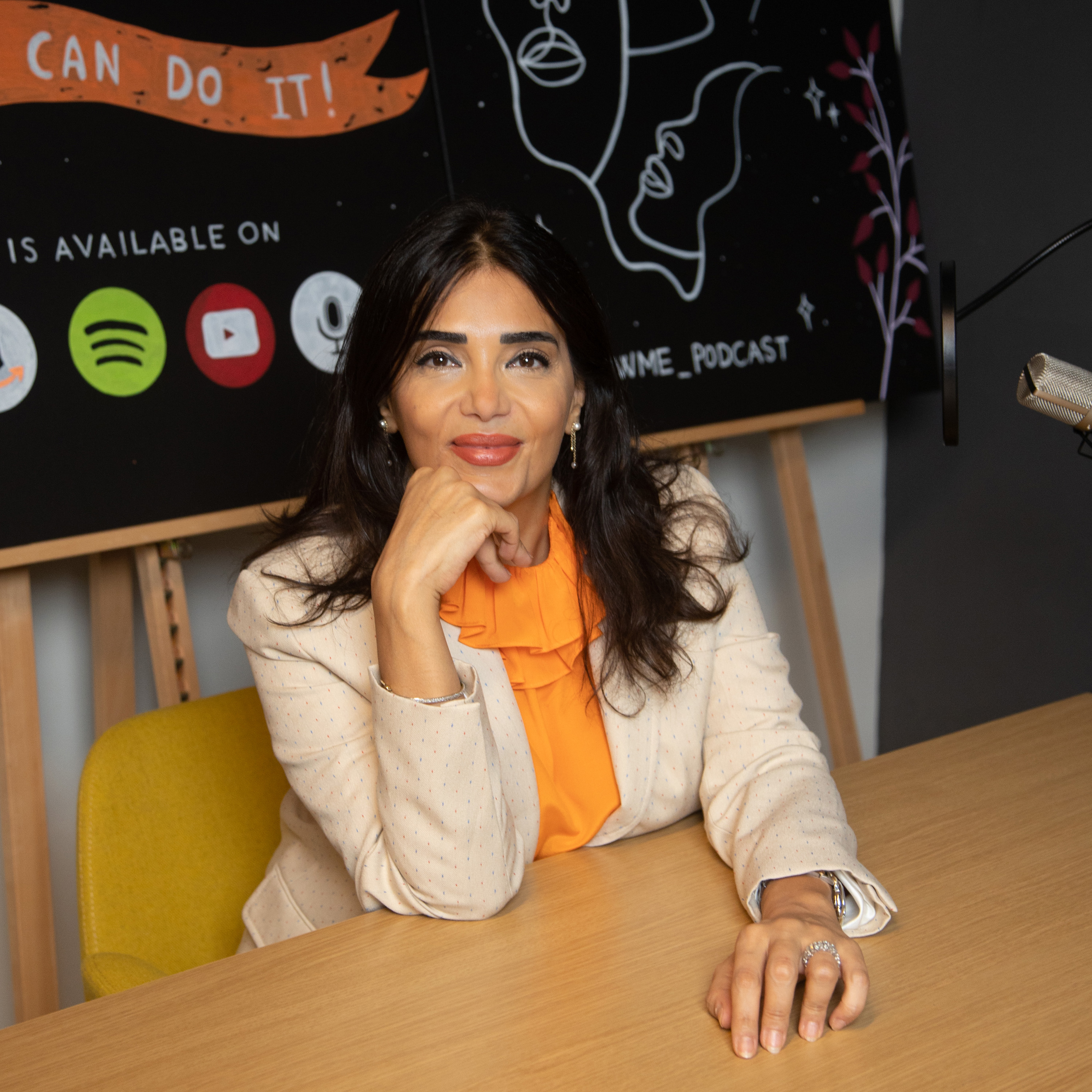
This podcast relates the realities of Arab women and their rich and diverse experiences. It aims to present the multiplicity of their voices and wishes to break overdue cultural stereotypes about women of the Middle East. My name is Amal Malki. I'm a feminist scholar and educator. This is Women of the Middle east podcast. Hello and welcome to Women of the Middle east podcast. I'm still in Amman, Jordan and I'm hosted by the wonderful podcasty. And here I want to thank all of the team who has been doing an amazing job. My trip to Amman wouldn't be complete unless I meet my dear friend, Dr. Silman Nims. Dr. Selma is an expert in gender equality, social inclusion and women, peace and security. Dr. Asan Mahari.
[00:00:55] Speaker B: Hi. Thank you for hosting me.
[00:00:57] Speaker A: Of course. As feminists, we have many concerns. Some of them are validated by data, and if we speak about data, you're the person. But we also have many concerns that are validated by our own experiences.
So I can think of one or two topics to converse about. But before that, tell us a bit about yourself.
[00:01:18] Speaker B: I will start with the most important role in my life. I'm a mother of two amazing young men, 21 and 17, Zain and Dawn. I'm very proud that my husband and I have raised what my children's teachers say, true feminist men.
[00:01:39] Speaker B: Without even trying to raise feminist men just by being an equal partners in our relationship and believing that we both have contributions to raising our children, to contributing to their well being, to our household's costs. Our children just grew up believing that this is the normal and that's why it was never forced in our family.
And this is what makes me proud. And I'm also proud to be a daughter of two very humble, amazing men and women who have all had their paths which were real challenges and struggles. My father is a refugee from Palestine in 1948. So I guess his story of facing injustice, leaving his own country, coming here and being given the opportunity to build a life in another country and feeling at home, and I have to say I'm a proud Jordanian for this and a mother who is from Jordan who also grew up in a very traditional family where she decided because of the context around her, not to finish her education, to get married early.
[00:02:54] Speaker B: But amazingly, she was also a very well read woman.
And growing up reading my mother's left books on the table, starting from Najib Mahfouz, Ihsan, Abdul Quddus, Nawal Sadawi, my mother read Nawal Sadawi. This combination of all of this and this is who I am as a person.
But also this is what made me go through a journey of self, self discovery, resistance, even from within the family. Because when you grow up in a family like my family, they're usually very protectionist and they raise us within a context in the 70s and 80s where I have to say I love my parents so much, but also they treated me differently from my older brother.
And I think this has raised many questions for me as a young woman. Why is he allowed to do this? And I'm not. And remember, I come from a privilege and I'm not going to be ashamed of that. My father struggled to send us to private schools. So imagine a young woman of privilege to even feel discrimination and affects her. And being a daughter of a refugee coming from a poorer background, Imagine for the young girls who are not as privileged, do not get the privilege that I get. Like going to high quality education, getting what I want in life, and yet feeling discrimination and frustration.
It put me in a place where I felt like I'm asking this question, not only for me, why there is discrimination. I'm asking it for every person, not only woman, who feels discrimination, inequality, poverty, unable to get the right to their self determination. If we talk about the Palestinians or the right to education, to work, to just being who they are because they chose who they are and that's who I was. And imagine all of this was really early on, between the age of 12 and 17, one would think I would have studied the law, but I ended up studying architecture and I actually excelled in it. Worked for three years on an amazing project that was more about urban justice. And that's why I enjoyed it for three years, to be honest. But after that project ended, I felt that this is not fulfilling to work on issues that are related more to social justice and equality. And that's when I decided to apply for studying at University College London to do my Master's in Sustainable development. And then from there I studied my Master's in Development studies. And of course the important part of this study, because people would assume I studied something related to gender equality, I studied in the most amazing department, University College London. It's called Development Planning Unit. This is a post colonial department. All of its teachers, most of them are from the global south. And those who are even not from the global south are really post colonial. So the whole approach was a critical approach to development.
And it was an amazing experience because it exposed to me all Issues of intersectionalities and inequalities.
That was when I started looking at concepts of policymaking and development from the perspective of women, of minorities, from the perspective of different race. And it was an amazing journey. And I actually did my PhD on social environmental conflict over water resources in the Jordan Valley. So again, people would assume that my fight for gender equality comes from a one angle of a woman fighting for women rights. But my perspective was actually it was about social justice, about the right for everyone to live in dignity and to have equal rights.
[00:06:51] Speaker A: And then this led you to a career in.
[00:06:54] Speaker B: This is the difficult part.
You were talking at the beginning about how we experience ourselves when this struggle as activists or feminists. So those who like to delegitimize me and delegitimize my fight, sometimes they spread rumors through social media, of course, using technology, videos, very well produced videos, saying, oh, she comes from a privileged background. So she got this position through her father's. My poor father who worked all his life in dust and in very difficult jobs.
They try to say that actually because I come from a family that has absolutely no connection to anything. I had nobody who worked in the UN system, nobody who worked in the government, nobody in banking. My father worked as a mechanic when he started his life. Then he became a subcontractor. He started his own business.
He was just all his life going every day to the desert, coming back and only on Sunday taking a day off.
So we had no connections, there was no social life. It's just only the family. So it was very difficult to be honest without a network to find a job, even with a PhD. I came back to Jordan and I thought, I have a PhD in sustainable development.
[00:08:08] Speaker A: It will take me like this.
[00:08:09] Speaker B: Yes. So I started sending out to every ministry I wanted to work in the government. I thought I didn't care about the salary. I sent it to every relevant ministry, to every UN organization. I didn't know how to apply and it was really difficult to find a job. And I ended up reading an advertisement for a very short project for six months to establish the gender division in the Ministry of Planning. And these six months I came to Jordan. My husband was in Saudi Arabia. I came with my young son who was two and a half years old. So I was supposed to be just a project manager. But when you have a PhD in this, you take this very seriously. So the six months became one year and I started doing more substantive work, pushing the envelope in the ministry. It was a UN women position inside the ministry.
And within one year I started doing consultancies on gender and development. So from the beginning all my work was mainstreaming gender issues with development issues.
One thing led to another.
So at some point I also had political career because I was outspoken about issues that are considered political.
And I became engaged and became the director of a platform called Taqaddam. It was a political platform that was seeking evolutionary change in Jordan at a time when revolutions were happening in the Arab region.
And that was a very important turning point in my career because this platform worked on different issues related to reform in Jordan. Not only political reform, it was about green economy, it was about social justice, gender equality, nationality, rights to children of Jordanian women. And through that I engaged with the opinion leaders in Jordan in the different fields.
And that what I think not, I think I know that when Her Excellency Asma Khadr had to resign from the Jordanian National Commission for Women because she became a senator, I got a call from the office of Princess Basma Bin Talal which until that point I would like to say I did not know in my life. I have not met in my life. I have no connection to royalty whatsoever. But simply it was because an ex minister recommended my name to Princess Basma. So you wrote it for you. Her name is Mahal Khatib and she's an amazing woman. And she's the one who recommended my name to be considered for this position.
And I got called by Her Royal Highness office. They said that she saw my cv, she saw my platforms, I told them, did she see my platforms? Did she see what I write on Twitter and social media? Because I don't think I would be accepted in this position.
And they said she did and she would like you to take the position.
And I met her, we spoke very candidly about who I am and that I will remain who I am. And she's a feminist, she's a true believer in gender equality. And she said, I give you the green light to do whatever is needed to push this organization forward and to fight for gender equality in Jordan. And really for eight years, whenever I was attacked social media, no matter how extreme it was, I never heard but support from Princess Basma.
[00:11:31] Speaker A: Amazing.
[00:11:32] Speaker B: Yes, yes.
[00:11:33] Speaker A: Tell me a bit about that title that you held for eight years.
[00:11:36] Speaker B: Yeah, I was. So the Jordanian National Commission for Women is the national women machinery in Jordan. So it is funded by the government but it has an independent status. Because when I was there it was not established by law. A law for it was adopted last year and it was established by Prime Minister's decision And actually it was established by late King Hussein and chaired by Princess Basma. And of course, as all national machinery, they would advocate for policy making for gender equality. Historically, the relation is not easy. Usually national machineries are considered state feminism.
And I came from the background of civil society and I said, this is not what it will be when I'm there. And that's what I spoke to Princess Basma. I said, I come from this background, is it okay for me to do it this way? And she said, do whatever it takes. I told her I will be fighting for nationality rights. And she said, you can try. You are welcome to try. I'm telling you, you might not get it, but you can try. And when I came, I decided that because our budget was very low and it used to compete with the civil society over funding and I said, this is not going to happen. And I had to build trust between JNCW and the civil society organizations. It was not easy. It took some time.
And of course we sometimes would have differences on different issues. But even within civil society, sometimes would be difference in positions.
However, we still had a very candid relation.
It took them some time to believe that I will not change my position on issues and I will still hold the same position over time. I think some of the changes that happened for women in Jordan is actually something that the women movement has called for for decades. And I think whatever is achieved at any moment in history, nobody can take credit for it at that moment.
It's a path, it's a process of creation. Sometimes, and sometimes a window opens and that window is that day. And we had these windows, for example, abolishing Article 308 that is relating to the rapist marrying his victim.
This is something that the feminist agenda put since the 90s, Jordanian women put it on the feminist agenda and the pushing by the international community for Jordan to abolish it. But this is not a Western agenda. This is what the Jordanian women put on the agenda to be pushed by the international community on the government.
But it took 30 years for the change to happen. But it was an accumulation of efforts.
To me, the abolishment was one success.
But how we worked together in tandem, how we supported each other, how we strategized, how we held the same voice and how we made it a Jordanian movement. You could see that we were pushing and it's happening. And then you start hearing like embassies calling you, how can we help? And I would say, stay out of the way.
[00:14:51] Speaker A: Exactly.
[00:14:51] Speaker B: We don't want your help. We are Doing this.
I always said when it comes to changing laws in Jordan, no funding should be put in it, not even one penny. You can carry out a whole campaign. You don't need money to do it. And we didn't. JNCW all the support it gave to the abolishment of 308 was done through peanuts funding our own budget throughout my at least the eight years that I was in the Jordanian National Commission for Women. I know and I am sure that whether it's civil society, the feminist movement ourselves, we would never propose any amendment for any law, even one article, especially when it comes to the penal code or the paternal status law.
We would never propose anything without consultation with the religious leadership and the specific religious institutions. And we would go through discussions and we look through the religious text. What are the religious historical evolution over these interpretations and how we can amendment to take into consideration.
[00:16:00] Speaker B: The current situation, taking into consideration religion and looking at examples from the Arab Muslim world and other laws and how we can learn from them.
So this continuous attack and delegitimization of the efforts of the women movement in Jordan, I believe that the pushback against them and it's not only the past two years throughout they are well organized, have better access and better reach and ability to distribute their narrative, which is something we have never been able to break through.
And that's why it became so spread socially that all feminists in Jordan are anti family, anti religion, which is not true.
This consistently happened with me when we were having discussions about specific articles and specific clause. And we would prepare really like a policy brief that is rooted in religious texts. And we have a legal team which has Sharia lawyers and Sharia scholars. So it's not me personally doing this, but we will be very well prepared.
So when I am called to debates or to TV shows, these talk shows, I would be invited with someone who comes from the extreme traditional side and.
[00:17:29] Speaker A: You have to defend yourself.
[00:17:30] Speaker B: I always wanted to be there because I had the logic, I knew I have the strong argument. But when I go on TV without that person, I will not get the same viewership if they come because they would have their own audience.
So they call me and I would say yes, I will come to that debate or to the TV show and I would say who's in front of me? And they will name the most.
[00:17:59] Speaker B: Vocal person against me in the parliament from the traditional side.
And I would be very happy and say fine, I want to argue with her, I want to stand face to face and I want to answer her lies. And how she is or he is actually distorting our argument. Because when they go on TV on their own or they make their own channels, nobody argues against it. So I'm ready for them. And they would say, okay. And then when I go to the.
[00:18:30] Speaker A: Show, they don't show up.
[00:18:31] Speaker B: They don't show up.
[00:18:31] Speaker A: Oh, wow.
[00:18:33] Speaker B: And they end up bringing someone else. Why? Because they know if they come to that channel and I'm sitting in front of them, all their viewers will be listening to the counter argument, which is quite clearly rooted, well prepared, and can actually discredit their argument.
But there are amazing Jordanian women who I'm proud to have learned from and to have worked with in those eight years.
[00:19:00] Speaker A: But you were taking the attack because you were amplifying all of this.
[00:19:04] Speaker B: Not only me, and there are others who were taking the attacks, and some of them were attacked even worse, and their phones have been hacked.
Now it's easy to discredit me because I'm not Muslim, but I believe, and I always said, we are Muslim by culture.
[00:19:22] Speaker A: Exactly.
[00:19:23] Speaker B: I think that Christian women and Muslim women in our region face the same narrative, the same discourse, the same discrimination. So when I fight for women in the Arab region, I don't fight for women from a certain religion. And I don't look at religion as the source. I look at the traditions. I look at the historical construction of discrimination, which uses religion as an excuse.
[00:19:53] Speaker A: Absolutely.
[00:19:54] Speaker B: Whether it's Christianity or Islam. And I'm telling you, we have laws in Christianity that have to be changed completely. The concept of submission, it's also in the Greek Orthodox Church law for us. I remember once a colleague who is Christian and she was divorced and going through a very tough time. She studied the laws because she was trying to fight for her many things.
She brought the law to me. I never looked at it. She said, doctora, do you know that in the Orthodox Church you cannot leave the house or work without your husband allowing you?
And I looked at the law, I looked at the article, and I went home and I told my husband, do you know that you can actually stop me from traveling alone? And he's. I've never known that. Maybe I have to start using it.
[00:20:43] Speaker A: Our religions and cultures are so intertwined to an extent that sometimes you get confused. Do you know that we had a debate about the whole myth that women are created from a crooked rib? The immense crooked rib that is entrenched in Islamic traditions? Not in Islam, in Islamic traditions, that they believe in it. And I had a scholar that traced it back there. Is no mentioning of that in the Quran. It's actually a Christian myth.
[00:21:12] Speaker B: Yeah, yeah.
[00:21:12] Speaker A: So nothing in the Quran says that we are born from a crack trib. We are so intersected that to because of the culture. Exactly.
[00:21:20] Speaker B: And we pick and choose what actually works for us. What works for us? For example, the concept of inheritance in Jordan, the inheritance for Christians we apply the Islamic Sharia in the inheritance. In inheritance.
But of course in other issues we apply the Christian laws.
[00:21:42] Speaker A: Does it work better?
[00:21:44] Speaker B: No. Why?
Because basically because it benefits men.
For example, land ownership. Nobody in our culture wants the husband of their daughter to get a share of the family's wealth. Whether it's land, whether it's cash, they have no problem. But land, its assets. Yes, yes. So basically I tell them, I argue in Islam a brother has to actually support to provide to his sister or his mother. But in our clause, a brother will not provide from me is not enforced by law. There is a complete system in Islam that justifies this.
And you come as Christians, you rob me of half of my share from inheritance, but you have no obligation to support me if I'm poor or if I'm suffering. Yes, of course, it's tradition. It has nothing to do with religion.
[00:22:41] Speaker A: It's an entrenched patriarchal structure and its.
[00:22:45] Speaker B: Power and it's access to wealth. This is about wealth and assets.
It's not about the values.
And actually to me all religions, especially Islam and Christianity. Because in the school system in Jordan we study Arabic through reading Quran. I still remember many of the Ayat and Asuwara and its beautiful language and amazing values. It's an amazing value system before anything else. And the same with Christianity. It came with a value system.
And then we take this, we forget the value and we look at, okay, how can we use some parts? So we are selective. If we don't look at the comprehensive understanding of what these religions were bringing when they historically came to our it.
[00:23:41] Speaker A: Becomes a matter of exclusion rather than inclusion.
[00:23:44] Speaker B: I read Fatima Al Marnisi when I was 19 years old. I wasn't even at the time a feminist.
And when I read her book and I thought, oh my God. Prophet Muhammad, peace be upon him, was a revolutionary man.
And he broke so many taboos at a time and he put set a very advanced at a time when women not only in Jahidiyya, but for Christian at the time in the European Christian world, women were completely owned by men.
And he came, peace be upon him. And he brought a religion that was like a revolution in social justice. True.
But People, they are selective very. In our campaigns on violence against women, what do we do? Even before I came in our campaigns, we would go to the field and we would have someone from the Supreme Justice Department or Al ifta, someone who is social and someone who is health expert. And we raise awareness on issues related to violence against women. And we bring men and women to these sessions.
The sheikh from.
[00:25:03] Speaker B: The would tell stories from the time of Prophet Muhammad, peace be upon him, and of how he treated his wives, how he would treat them equally, how he would help at home, and how he would play with them. All the positive things.
And I remember in one of the cases, one of the men who was sitting in the front looked at the sheikh in his face and he said, jump over this.
He said, skip this part, Sheikh. Skip this part.
I'm sorry, you don't choose to skip according to what you believe benefits you. And that's the sad part. And that, as I said, that's why I believe that the pushback that is happening today on gender equality issues, and I would say equality between men and women specifically, is now we see an alignment, an alliance between the extreme Christian right in the west and the traditionalists in our region.
Why are they doing that? Because they felt the power of women.
The change that we're bringing is not only a social change.
Even the feminist movement, when they say we are against the family. All what the feminists were doing in the past 10 years minimum, is talking about care as a right.
Okay. And that you have to change the structure of the economy and the work in order to allow for the right for men and women to care for their families. So actually the approach is family based. Totally. Okay, so then what is the problem? The problem is the capitalist system.
And those are the capitalists. They're not those who care about religion. They are capitalists. They are benefiting from abusing women, paying them less salaries, abusing female farmers to accumulate wealth.
So we were challenging systems and asking for more healthy families.
But healthy families means equality between men and women and some men, because they don't have their rights, political rights, and economic rights outside the private sphere because of the oppression of the patriarchal systems, authoritarian systems. Then to them, the threat of equality is the fact that they will lose their power inside the private sphere, which.
[00:27:34] Speaker A: Is the only sphere they have control over.
[00:27:35] Speaker B: Exactly. So that's what's happening in our area. At the same time, who is the extreme Christian right in the West? They are the capitalists. They are the neoliberal, those who are benefiting from the liberal system that they are not willing to change the power relations between the capital and labor.
They use religion, it's the easiest way. Religion and family and the destruction of the family.
[00:28:02] Speaker A: And they hijack the narrative. And this is what sometimes kills me really, that they want to hijack even our narrative.
[00:28:09] Speaker B: They hijacked it already.
[00:28:11] Speaker A: But we need to stop them. It's not just that this hate speech that is fueled with sexism will be translated into attitudes and social norms that will be normalized. We need to stop that.
[00:28:23] Speaker B: And what is the problem? Also, because we see a lot of women who have worked in the past 20 years and they had all the sole responsibility of the household because their husband would not contribute to it and she would be working, contributing to the income of the family. And then this is not recognized.
Some of those women, they are standing with the same narrative because they're tired, because the system did not change. The system used them. So to them, maybe women should stay home. Maybe men should be the only providers. And we want to rest, we want to gain back our role as mothers. I'm telling you, I keep telling my story as a mother because I enjoyed every moment of being a mother. And I enjoyed it even while I worked. Because I had a husband who believed in my right to work and supported me as a father with our children.
And also when I contributed to the income of our household, it translated into equal assets in our ownership, in everything.
So I didn't lose any rights. He didn't lose any rights. There is no concepts of control in our family. And we managed to raise amazing children and give them the best opportunities in life because we both worked. In this context, two income families has become a necessity.
At some point, the capitalist system actually stole my husband's savings. He came back to Jordan and they did not pay him all his end of service. They did not pay him his salary. What could we have done at that point if I wasn't a working woman? We saw that we had the same responsibility equally.
[00:30:15] Speaker A: What do you think of a privileged woman who doesn't need to work? And we can see those examples, especially from where I come from in Arabian Gulf. Who doesn't need to work, who's sitting at at home? Good for you. Really, no judgment.
[00:30:27] Speaker B: You know what? I support any woman's decision to do whatever she does.
[00:30:32] Speaker A: But attacks feminists.
[00:30:35] Speaker B: Exactly. You cannot attack feminists because they believe in work. You are lucky that you are privileged. And maybe you have a good husband or father who is not an abusive person who is giving you your rights. As well for freedom of movement to go and get educated.
But I have stories of privileged women who ended up after 30 years of marriage being tossed aside by their husbands, marrying a younger woman. And these women had no $1 of saving in her name. And then according to the law, this type of divorce, which is, I think it's called a tasophy, which is meaning that it was not consensual without reason.
What is the best alumni that she would get? It would be an alumni of three years.
So they calculated that how much she would need monthly in three years and this would never reach more than say what, 5,000 JD or $10,000.
She doesn't have young children anymore. So she doesn't have her wife to.
[00:31:44] Speaker A: Stay in a house.
[00:31:45] Speaker B: No, in Jordan, even if you have the custody of the children, you don't get the house.
Yes, he pays us the rent of the house. Sometimes it's no more than $100. So basically a woman who is like 50 something ends up with no job even if she had studied. She has education but no experience. Her children are already spread around the world in their jobs. They have their wives, their households.
She loses the house. Her husband is married to this 30something young woman.
[00:32:15] Speaker A: 20Something young woman, no, I want to.
[00:32:17] Speaker B: Be nice to him.
And these women are ending up waiting for their children to allow them to live in their homes and help them.
So all we say, when I advise, I say make that choice.
It's okay, it's your choice. I actually had the choice of not working.
I had the choice of working part time because I was privileged. But some women actually do not even have the luxury of that choice. If they don't work, their family would not survive.
And I've seen it. I've seen it in the Jordan Valley. I've worked in the Jordan Valley, I've had done fieldwork there.
Farmer women are actually sending their children to private universities in Jordan.
And you go to their homes and you see they're building their homes and the husbands are lying on the side smoking cigarettes and she's buying him his pack of cigarettes.
These are amazing women. These are leaders. They are really raising the new generation in Jordan. But this woman, if nobody recognizes her contribution to her household, what will happen to her?
This is the question.
I support your decision as long as you support protecting other women's rights to decide what type of life they want to choose.
[00:33:43] Speaker A: Oh, I love this. I didn't need to prepare any questions.
Now you will leave me with several ideas. So the whole dichotomy between Private and public. We know it, we've wrote about it, we talked about it a lot. And we are against it because it doesn't really describe. Describe the lived realities of women in our region, but also now the whole dichotomy between victim and privileged. Okay? Because remember, when you are represented as a victim, this is very colonial, reductive, essentialist representation of Arab women or Muslim women being victims. But this is the representation that would bring funding, for example, for women organizations from the west, right?
[00:34:23] Speaker B: Yes.
[00:34:23] Speaker A: As long as you're a victim or you're speaking about women who are victims, we will fund you to work on whatever project you want. But we spoke about privilege a lot. And this is something that I also suffer from.
Whatever you consider privilege. I'll take it. I'm not gonna argue with you. You think I'm privileged. Thank you. This really doesn't take into consideration everything I went through, okay? That is seriously, whatever privilege you think it is had nothing to do with it until I reach to this point. But at least I've reached to this point, and I'm turning this privilege into a platform for other women, right? I'm trying to help other women. I'm doing something good with this privilege. You're leaving me with this. Maybe we need to eradicate this dichotomy between victim and privilege. There is no such a thing when you're a woman.
[00:35:12] Speaker B: And I know you're wrapping up, but this brings me to the very important story as well that is being used all the time.
These super women, okay? I made it out of nothing, okay? So these.
There are lots of women who are now entrepreneurs who are put on a stage, and they would start saying, you can do everything. I've done it. I started from nothing. And I went from here to there, and now this. Because sometimes I'm speaking in these same events and I'm looking at these women and thinking, what pressure are you putting on a young woman coming from a marginalized community and telling her you can do it when she can't? Because you are not telling the battle as it is true. And you are not saying that you happen to have windows of opportunity that not for everyone. Sometimes it's coincidence that gets you from one story to another.
Also, we should not put so much pressure that you can make it on your own. We all have to be entrepreneurs. No, we don't all have to be entrepreneurs.
I want them all to have equal opportunity to education, quality education, quality health, and equal opportunity to jobs, to access jobs. And maybe if she wants to be an Entrepreneur. Maybe she would succeed an entrepreneur. But not all of us, men or women. This pressure that everyone can become Steve Jobs. I'm sorry, no, we can't. I want the system, I want the government. I want the whole system to support me. Even if my salary is only the minimum sale, minimum salary, because there are people who will have the minimum wage. But there is a responsibility that they should get equal rights to services, to education, to health, to transportation. They don't. Not everyone has to be wealthy, but everyone has to live in dignity. And that's what we need to fight for.
So no, I will not claim that I have their voice. At least. While I was in jncw, we listened. We went to the field and we listened and we brought the stories as they are. We made them decide what are the priorities and we put them in a national strategy. It wasn't our stories, but yes, we have to admit our privilege. And the most important thing is to use it to the better of the world around us.
[00:37:34] Speaker A: I've written about strategic role modeling. It's people like us, right, who not only speak about where they reached, but more of what they went through, the hurdles they went through. So hopefully one day we will be a huge push for someone else.
[00:37:47] Speaker B: Hopefully.
[00:37:48] Speaker A: Inshallah. You made my trip. This is all I'm gonna say. You made my trip.
[00:37:52] Speaker B: You made my day that you're in Amman, actually.
[00:37:55] Speaker A: Thank you so much.
[00:37:56] Speaker B: Thank you, thank you.
[00:37:57] Speaker A: This is Women of the Middle East. Thank you for listening and watching to stay up to date with Women of the Middle east, both. You can subscribe and don't forget to rate us. If you would like to contact me directly, you can do so on Instagram or via email.